The POWER Scan™: A Behavioral Diagnostic for Governance Capacity In the Age of AI

Assessing organizational capacity before risk becomes exposure
At the Corporate Governance and Ethics in the Age of AI Summit, I asked a room of compliance and board leaders how explicitly their boards had discussed AI's impact on workforce skills in the prior six months. Half had not discussed it at all. None had it as a standing agenda item.
We see this across advisory engagements with financial services, healthcare, and technology organizations: deployment decisions move through governance channels, receive business case approval and legal sign-off, and land in operations. The question of whether the organization has the capacity to oversee what it just authorized doesn’t surface until something goes wrong.
The governance gap in AI runs deeper than technology. The frameworks organizations use to govern AI were designed for static systems reviewed on quarterly or annual cycles. AI-enabled systems learn, adapt, and generate decisions continuously. A risk committee that convenes four times a year to review processes that make thousands of decisions per day is not providing oversight. It is providing the appearance of it.
Boards already have governance frameworks. What they're not asking is whether those frameworks can operate at the speed and behavioral complexity of the systems they're meant to govern.
Governance Capacity Is Not the Same as Governance Structure
Organizations with sophisticated compliance infrastructure routinely discover, during enforcement actions or post-incident reviews, that their frameworks did not function as designed. Policies existed. Reporting lines existed. Audit cycles ran on schedule. What was absent was the organizational capacity to operate those structures under conditions of real complexity.
In AI governance, three capacity gaps appear consistently in our work:
Oversight Literacy. The people formally responsible for AI governance frequently lack the technical fluency to assess whether AI-driven decisions are producing material errors. Organizations have assigned oversight responsibility without assessing whether the assigned parties can discharge it. When a system makes decisions no one on the oversight team can evaluate, accountability becomes nominal.
Accountability Architecture. When AI-related failures create regulatory exposure, the answer to "who is responsible" tends to produce a list of functions rather than a person. IT owns deployment. Legal owns regulatory risk. HR owns workforce impact. Compliance monitors. The accountability structure assumes human decision-makers who can be held responsible for decisions they understand. It does not account for decisions made by systems that none of them fully control or can explain.
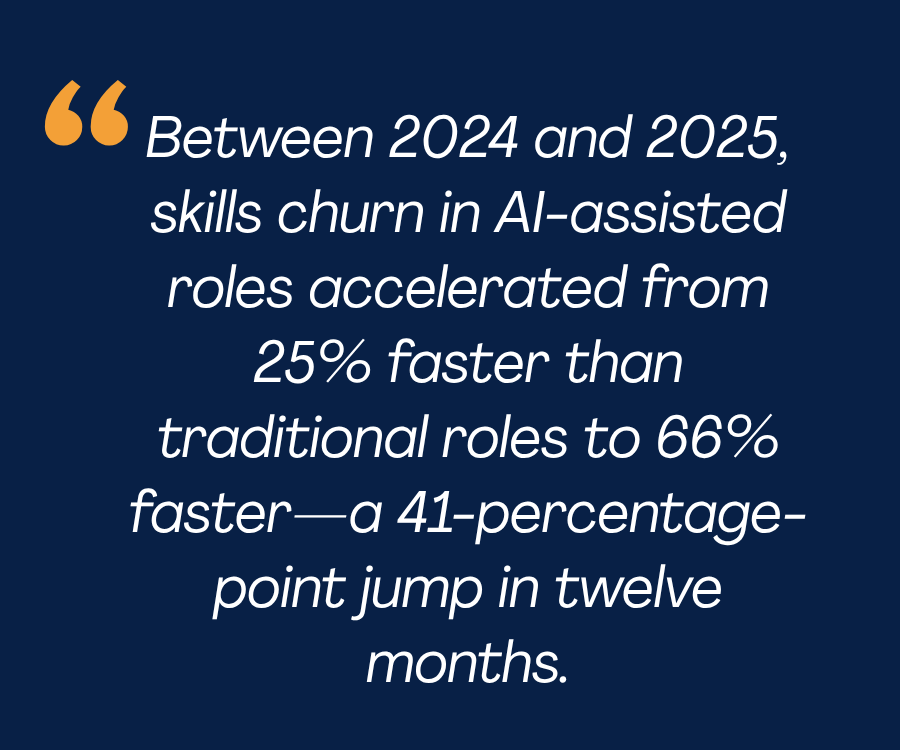
Governance Velocity. Between 2024 and 2025, skills churn in AI-assisted roles accelerated from 25% faster than traditional roles to 66% faster, a 41-percentage-point jump in twelve months. That compression rate renders annual governance review cycles structurally inadequate. The organizations best positioned for enforcement scrutiny are those whose governance cadence matches the operational pace of their AI systems, not those whose cadence matches the calendar.
Introducing the POWER Scan™: A Behavioral Diagnostic for Governance Capacity
Governance capacity is not revealed by reviewing policies. It is revealed by examining behavior: how decisions are made, where accountability sits, whether employees can and do speak up when systems produce questionable outputs, and what values guide deployment choices when speed competes with oversight.
Eunomia's POWER Scan™ is a behavioral diagnostic built around five dimensions that together map where governance capacity exists in practice, and where it does not. The framework was first published in the journal Leader to Leader (Wiley), as "Reckoning with Power: Why Distance Matters in the Age of AI and Global Disruption."
POWER maps five dimensions of behavioral governance capacity:
Perceived Authority
Organizational Voice
Workflows and Decision Rights
Ethical Anchors
Reinforcement Methods
Perceived Authority. Who is trusted to make AI governance decisions, and does that trust map to capability? In organizations where AI governance is nominally owned by a committee but operationally deferred to the technical teams who built the systems, the authority structure on paper and the authority structure in practice are different. Misaligned authority doesn't just create confusion; it creates unowned risk.
Organizational Voice. Can employees raise concerns when AI systems produce outputs that appear erroneous or harmful? This dimension examines whether escalation pathways exist, whether they are used, and whether those who raise concerns experience consequences that discourage future escalation. A governance framework in which concerns cannot surface is not a framework. It is documentation.
Workflows and Decision Rights. Are AI governance decision points visible, understood, and fairly distributed? Organizations deploying AI at scale often discover that the actual decision rights around oversight have not been mapped. No one has specifically assigned authority to stop or modify a system producing questionable outputs. No one has clarity on what evidence threshold triggers intervention. The workflow assumes governance will happen without specifying how, and that assumption is where liability accumulates.
Ethical Anchors. What values guide AI deployment decisions when efficiency and oversight come into tension? Organizations that treat ethical review as a post-deployment compliance step rather than a deployment prerequisite tend to encounter the same categories of downstream failure repeatedly. When ethical considerations are applied only after something goes wrong, they function as incident response, not governance. The pattern is not bad luck. It is architecture.
Reinforcement Methods. How is responsible AI governance behavior modeled and sustained? Frameworks that exist only as policy documents atrophy. Frameworks actively reinforced through leadership behavior, recognition structures, and accountability mechanisms hold under operational pressure. This dimension examines whether the conditions for governance exist in daily operations or only on paper.
Why Behavioral Diagnostics Surface What Framework Reviews Miss
Organizations that conduct pre-deployment governance assessments using traditional methods (reviewing documentation, confirming policy existence, mapping reporting lines) tend to produce findings that look clean. The framework is in place. The policies are current. The committee meets quarterly.
What those reviews do not capture is whether the framework functions under operational conditions. That's the assessment gap POWER Scan™ was built to close. By examining how authority, voice, decision rights, ethics, and reinforcement operate rather than how they are documented, behavioral diagnostics surface the failure points that standard audit cycles miss entirely.
In practice, this means boards receive information they cannot get from documentation reviews: whether compliance and risk teams have the technical fluency to oversee AI decisions in real time, whether the people accountable for governance outcomes have the capability to discharge that accountability, and whether organizational conditions exist for concerns to surface before they become material risk.
The capability question is not abstract. The World Economic Forum finds that roles increasingly require a 50/50 split of technical and human capabilities, including critical thinking, analytical reasoning, and resilience. Governance structures that haven’t mapped where those capabilities exist within their oversight functions have a gap. And gaps in oversight tend to get filled by the people with the least incentive to flag problems.
Building Governance That Functions, Not Just Governs
The organizations best positioned as AI oversight intensifies are not those with the most comprehensive policy documentation. They are those whose governance structures have been tested against how the organization behaves under operational conditions.
That requires examining behavior, not frameworks. It requires asking whether authority maps to capability, whether employees can raise concerns without consequence, whether accountability is real or nominal, and whether ethical considerations are embedded in deployment decisions or applied only after something goes wrong.
The gap between having a governance framework and having governance capacity is not inevitable. Closing it means treating governance readiness as a pre-deployment condition, not a post-incident finding. While this analysis addresses AI governance capacity, the POWER Scan™ applies wherever governance frameworks exist on paper but may not function under operational conditions: compliance programs, third-party oversight, ESG commitments, or any structure where accountability is assumed but not tested.
The organizations that don't close this gap will discover the difference when regulators ask not whether a framework existed, but whether it worked.